
The Indian logistics sector is on a big growth tide. According to the domestic rating agency ICRA, Indian logistics sector is expected to grow at a rate 8-10 per cent over the medium term. This is an improvement over the compound annual growth rate (CAGR) of 7.8 per cent at which the industry grew during the last five years. The logistics industry of India is currently estimated to be around US$ 160 billion. With implementation of GST the sector is expected to benefit and touch US$ 215 billion over the next two years, as per the Economic Survey 2017-18.
The last couple of years have seen significant development for this industry which is reflected in the global rankings. According to the Global Ranking of the World Bank’s 2016 Logistics Performance Index, India jumped to 35th rank in 2016 from 54th rank in 2014 in terms of overall logistics performance. The report also showed that India’s logistics sector has improved its performance on all the six parameters used in the ranking. This is a huge jump of 20 ranks and clearly indicates the growth of the sector.
There is a lot of investment that the industry is attracting and as a result of the transformations and changes led by these investments, the industry will stimulate job creation. The experts predict that it can be the largest job creator by 2022.
The sector currently provides employment to more than 22 million people in the country. The report also emphasises that improving the sector would result in a 10 per cent decrease in indirect cost, in turn leading to a growth of 5-8 per cent in exports.
The Indian government has announced that it is working at the policy in order to set up new logistics plan in the country. The intention is to devise the most cost-effective method to transport goods by the year 2035.
The policy aims at preparing a proper integrated logistics plan. The new logistics division within the department of commerce is working on this national integrated plan, with the objective to identify and iron out any existing bottlenecks and gaps in the industry.
This is good news for the sector. It will also encourage tech-enabled startups in the logistics sector as they will be able to provide seamless movement of goods across the country.
Key Drivers
Indian logistics industry is a sunshine sector and there are multiple factors that are driving this sector towards growth and boom.
The growth of logistics is two sided – led by demand supply. The demand led growth is strengthened with the economic recovery and benefits from implementation of GST. According to the rating agency ICRA, post GST implementation the savings in terms of truck turnaround time has been approximately 18-20 per cent.
Also, the outsourcing of non-core activities like warehousing and associated activities to integrated players is leading to strengthen the organised players, which in turn is good for the industry in long term. The picking of industrial consumption is another driver on the demand led growth of the logistics industry in India.
The supply led growth drivers include improvement in logistics infrastructure, integrated logistics and birth of numerous logistics start-ups, especially tech led start-ups. According to an industry expert, “Tech-enabled startups have a huge scope to grow as well drive the growth of the sector. Not only they are attracting heavy investments, they have the potential to make export procedures hassle-free by reducing unnecessary paperwork, in turn reducing delays in delivery.”
Trends
According to the real estate consultancy CBRE’s report titled ‘2018 Asia Pacific Real Estate Market Outlook’ Delhi-NCR, Mumbai and Bangalore dominated the warehousing space demand with 50 per cent share. Although, the smaller cities have been on growth spurt too with the share of Hyderabad, Chennai, Kolkata and Pune in overall transacted space went up to 49 per cent in 2017 as against 25 per cent in 2016.
Another key trend is the preference for large warehouses that allows better automation process. According to the CBRE report, the Indian market for warehouse automation is estimated to grow by 10-12 per cent to US$ 3.49 billion by the year 2020.
Warehousing emerging as an attractive investment is another dominant trend in the Indian logistics sector. Some of key investors include Ascendas-Singbridge, Morgan Stanley, and Warburg Pincus, beside others. The investment burst in the sector is leading to development of new and better warehousing facilities.
Way Forward
According to CRISIL the future for the Indian logistics industry is going to shine even brighter. The research firm suggests the logistics industry of India which stood at Rs 6.4 trillion in FY17 will grow at a CAGR of 13 per cent over the next three years and will be at Rs 9.2 trillion by FY20.
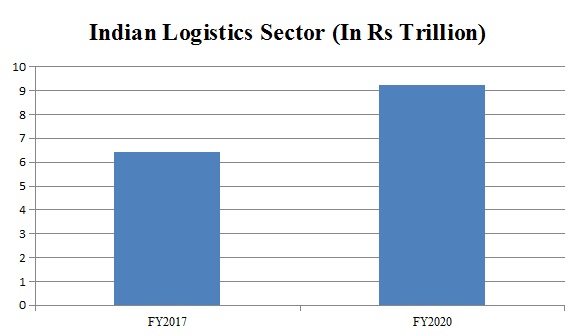
Source: CRISIL
The government of India is also taking significant steps to support the sector and boost its growth in the times to come. The commerce and industry ministry has decided to give a one-time funding of Rs 8 million to the sector for building up initial infrastructure and a phase-wise support of Rs 33.9 million for four years.
The government’s focus going forward is to bring down the cost of logistics which is at 14.4 per cent of India’s GDP at present. The aim is to bring it down to 10 per cent level in the next four years. This is a very significant move and will boost the competitiveness of the sector and will be significant for its further growth.
Going forward, strategic investment and government initiatives to support the sector are going to be crucial for the logistics industry in India. If the cards are played right, the sector has the potential to create huge number of jobs for the countrymen and play a key role in driving the economy on a high wave


